AIWORKX is an AI solutions company that supports the entire arc of AI development — from data construction to model development, AI agents, and AI/SW verification. Selected in 2022 as an implementing partner for KOICA’s Inclusive Business Solution (IBS) program, the company built AI data training and processing capacity in Vietnam and ran IT education and employment-linkage programs for vulnerable groups. Since March 2026 it has been running the Phnom Penh AI Ecosystem and Digital Jobs Creation Project in Cambodia.
“Not a project that disappears when the aid ends, but a structure where the local entity and local people remain and keep it running on their own — that is the private sector’s way of scaling an AI-inclusive society into a global standard.” — Yoon Seok-won, CEO, AIWORKX
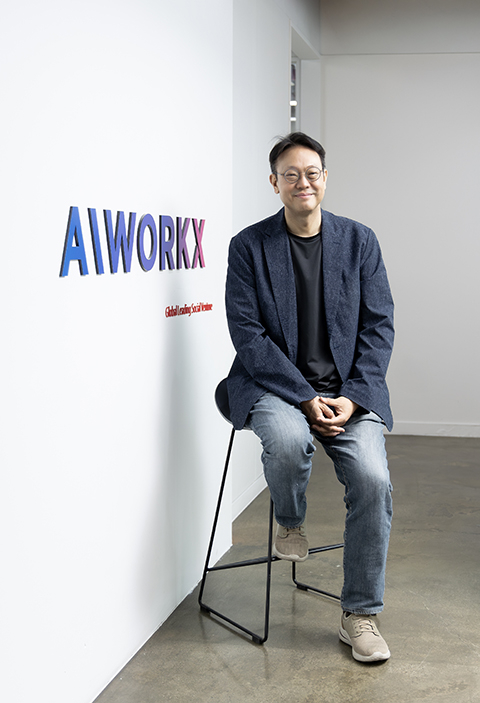
Born in 1972. Studied journalism and broadcasting at Korea University and holds a master’s degree in computer science from Cornell University. Led quality assurance for large-scale software projects for more than 20 years at Microsoft headquarters in the United States and at Samsung Electronics. Founded Testworks in 2015 and, marking the company’s tenth anniversary last year, renamed it AIWORKX while expanding into AI solutions. The company has selected underwriters and is preparing for an IPO.
A social venture built on inclusive hiring
What kind of company is AIWORKX?
We build AI technology that helps people — testing, verification, data construction, and agentic AI solutions. We started in 2015 as Testworks, doing software testing. It was a social venture that combined the precision of people on the autism spectrum with the communication strengths of women returning to work, forming teams that handled demanding work. Today we have grown into a social venture spanning AI data, models, agents, and reliability verification. We are a KOLAS-accredited international testing laboratory in the software field, and we recently launched AIWORKX AgentRigor™, a reliability evaluation solution for AI agents.
What led you to connect employment for people with developmental disabilities with the AI data business?
It was not a strategic calculation. It began with wanting to create jobs for people with developmental disabilities. Software testing is repetitive and highly standardized work, which suits the strengths of people on the autism spectrum. But testing work in Korea generally requires on-site deployment at the client’s premises for security reasons, and that was a barrier. So we shifted to data labeling, which can be managed remotely, and that became the starting point of our AI data business.
Do you still maintain that inclusive hiring approach?
Of about 160 employees, 15 to 16 are employees with disabilities and roughly 20 are women returning to work. We have an autistic employee who leads a project team. What matters is not how many people you hire but how much you help them grow.
KOICA’s IBS program as a springboard for going global
A market-based public–private cooperation program run by KOICA that links a company’s own business capabilities to development cooperation, addressing unmet needs and structural problems in developing countries while pursuing both corporate revenue and development outcomes. Projects run for two to five years, with KOICA funding capped at KRW 500 million per year. From 2010 through April 2026 the program has identified 213 projects across 34 countries and mobilized KRW 380.7 billion in development financing (KRW 219.2 billion from KOICA, KRW 161.5 billion from partner companies).
Was it the same reasoning that drew you to developing countries?
The company began with the idea of creating jobs for people excluded from technology, especially those in vulnerable employment. In Korea we spent ten years on web and app software testing, embedded testing for areas such as semiconductors, and data construction work. The faster AI advanced, the more visible the people who could not reach that technology became. The digital divide keeps widening. AI develops in advanced economies with English at the center, and young people in developing countries find it hard to use AI services in their own languages. We expected that inclusive jobs plus digital AI technology, the foundation of our growth, would also work in developing countries, and we believed that using ODA as the connecting link would make a mutually beneficial business possible rather than one-way assistance.
You are now running a Khmer-language AI agent project in Cambodia with KOICA’s support.
KOICA’s IBS grafts a company’s proven business model onto ODA, solving social problems in developing countries while building a sustainable business base for the company. We are running the Phnom Penh AI Ecosystem and Digital Jobs Creation Project from this spring through the end of 2030. The idea of an AI company doing ODA may sound unfamiliar, but if digital aid until now has centered on infrastructure and computerization — digital transformation — it now has to advance one step further, layering AI that works in the local language on top of that: AI transformation. Applying Khmer data and AI agents to local administration and public services can accelerate Cambodia’s digital government transition, and in that process the next generation can move from manual labor to becoming the agents of a digital industry through data construction.
“Low-resource language” is an unfamiliar term for most people.
AI grows by consuming data. Khmer is spoken by some 17 million people, yet it is a low-resource language with an acute shortage of digital data for AI to learn from. According to UNESCO, only about 1,000 of the world’s roughly 7,000 languages exist online. The remaining 6,000 or so are effectively excluded from the AI era. UNESCO has framed linguistic inclusion as a matter of human rights and social justice now that AI underpins public services, education, and jobs. The numbers make it clearer: in Common Crawl, the source of much of the world’s AI training data, English documents account for 41 percent of the total while Khmer accounts for just 0.009 percent — a gap of roughly 4,370 times. A language gap becomes an AI gap, and an AI gap leads to gaps in education, healthcare, and financial information. It is a new structure of inequality in the AI era.
What role do the Khmer speech and text datasets actually play?
Over the project period we will build more than five million sentences of Khmer AI training data, serving three purposes. First, it is the raw material that teaches large language models to properly understand and generate Khmer. Second, it becomes the basis for speech recognition and speech synthesis — which is why we are building speech datasets alongside text. Considering digital accessibility, a voice interface may matter more than text in Cambodia. Third, on that foundation we run proof-of-concept work for Khmer AI agent services in the public and private sectors.
Cambodia as an evolution of the Vietnam experience
You also ran an IBS project in Vietnam from 2022 through this year.
We were selected for the IBS program back in our Testworks days and carried out a model in Vietnam that built data-processing capacity through AI data construction training and connected IT education for vulnerable groups to employment. We ran a training center in Hanoi, delivered education for people with developmental and physical disabilities, and established a local entity in order to hire them. The greatest asset turned out to be something money cannot buy: trust with the local government and institutions, an understanding of local rules around employing people with disabilities, and the experience that an inclusive hiring model proven in Korea also works abroad.
What changed locally in Vietnam after the project?
A shift became visible — people with disabilities being seen not as objects of protection but as talent for the digital economy. As graduates went to work in data roles, their families and communities saw for themselves that economic independence was possible. Internally, we also learned how a curriculum built in Korea has to be localized for a different language and culture, and that know-how became the backbone of how we designed the Cambodia project.
How does the Vietnam experience help in Cambodia?
Three things. First, we validated in Vietnam a step-by-step curriculum for teaching AI data work to learners with differing levels of digital literacy. Second, there is the pipeline that runs from education to practical training to employment to commercialization — not ending at education, but moving through real project work into jobs and business creation. The last is the local-instructor model. Only when local people are the ones teaching does an ecosystem remain after the project ends. That is why we aim to train more than 50 instructors in Cambodia.
So AI education and training local instructors are the main pillars.
To be precise, it is an ecosystem project with five interlocking pillars: building and quality-checking Khmer speech and text datasets; AI education for young people and the digitally underserved, with a target of 450 graduates; training more than 50 local instructors; establishing and operating a local entity; and the education–practice–employment–commercialization delivery structure. These five do not run separately. The essence of this project is a virtuous cycle: trained people take part in building data, that data becomes AI services, and those services in turn create jobs.
What is in it for young Cambodians?
In the immediate term, digital jobs and vocational capability. AI data work has a low barrier to entry yet strong global demand, and graduates can build practical experience through projects at the local entity. In the longer term, it is the right to enjoy AI in their own language. Once a Khmer AI ecosystem exists, rural residents who do not speak English can reach administrative, educational, and medical information in their own language. Most important is that young Cambodians become producers in the AI industry rather than consumers of it.
The private sector’s way of scaling an AI-inclusive society
The Korean government has been emphasizing a “global AI-inclusive society.” There must be a role for private companies as well.
An AI-inclusive society is a vision of everyone sharing the benefits of AI, and I see it not as a welfare argument but as a strategic frame for Korean companies going global. Korea’s social ventures and impact companies are already the ones practicing this on the ground. If the government sets the direction and KOICA provides the connection, private companies should build sustainable ecosystems on the ground with proven business models. Institutionally, I would create an ODA-type AI PoC track in three-to-six-month units, validating small-scale field demonstrations first and then linking the results into KOICA’s main projects, international organizations, and MDB projects — while putting in place guidelines on local data ownership, personal data protection, and AI ethics.
What commercial return does AIWORKX expect from this?
The opportunity is clear. Southeast Asia alone has a line-up of low-resource languages including Lao and Burmese, and the playbook we build in Cambodia can be extended to neighboring countries simply by changing the language. What governments need most when adopting AI in their own language is verification — and combined with the strength of AIWORKX AgentRigor™ for verifying AI reliability, we can build a meaningful position.
So the AI market in low-resource language countries is effectively a new market.
Three currents are arriving at once. The first is sovereign AI — governments have begun to see national-language AI capability as a strategic asset. The second is the popularization of open-source and lightweight models, opening a path to national-language AI without vast infrastructure. The third is the leap toward multimodal-centered interfaces beyond text. A large market opens where these three meet, and that market will belong to companies that build ecosystems together with local people rather than those that simply sell technology.
“The future of AI will not be decided by performance competition alone. How much public value and inclusion you build into the design is the real competitive edge.” — Yoon Seok-won, CEO, AIWORKX
Read the original article