One Year After the Rebrand, Inclusive AI, and AIWORKX at Eleven: A Conversation with Our CEO
After a long deliberation over what the opening post of this blog should be about, I decided to stay true to my interviewer’s instincts and my interest in people and their stories. I asked our CEO for a conversation.
This year has had an unusually heavy overseas schedule. With the agenda widening to include advisory work for government agencies and public lectures, it felt like the right moment to take stock of the CEO’s thinking and the company’s direction in one sitting. The questions were shared in advance as six keywords.
- Q1. One year after the rebrand, how do you see the recent changes in AI?
- Q2. The digital divide and inclusive AI: how do you think about this topic?
- Q3. The KOICA IBS program: from Vietnam to Cambodia
- Q4. AI trustworthiness and safety are the topic of the day. How do you read this landscape?
- Q5. AIWORKX, a social enterprise in its eleventh year: what it does well and what it lacks
- After the official interview: two things on his mind these days
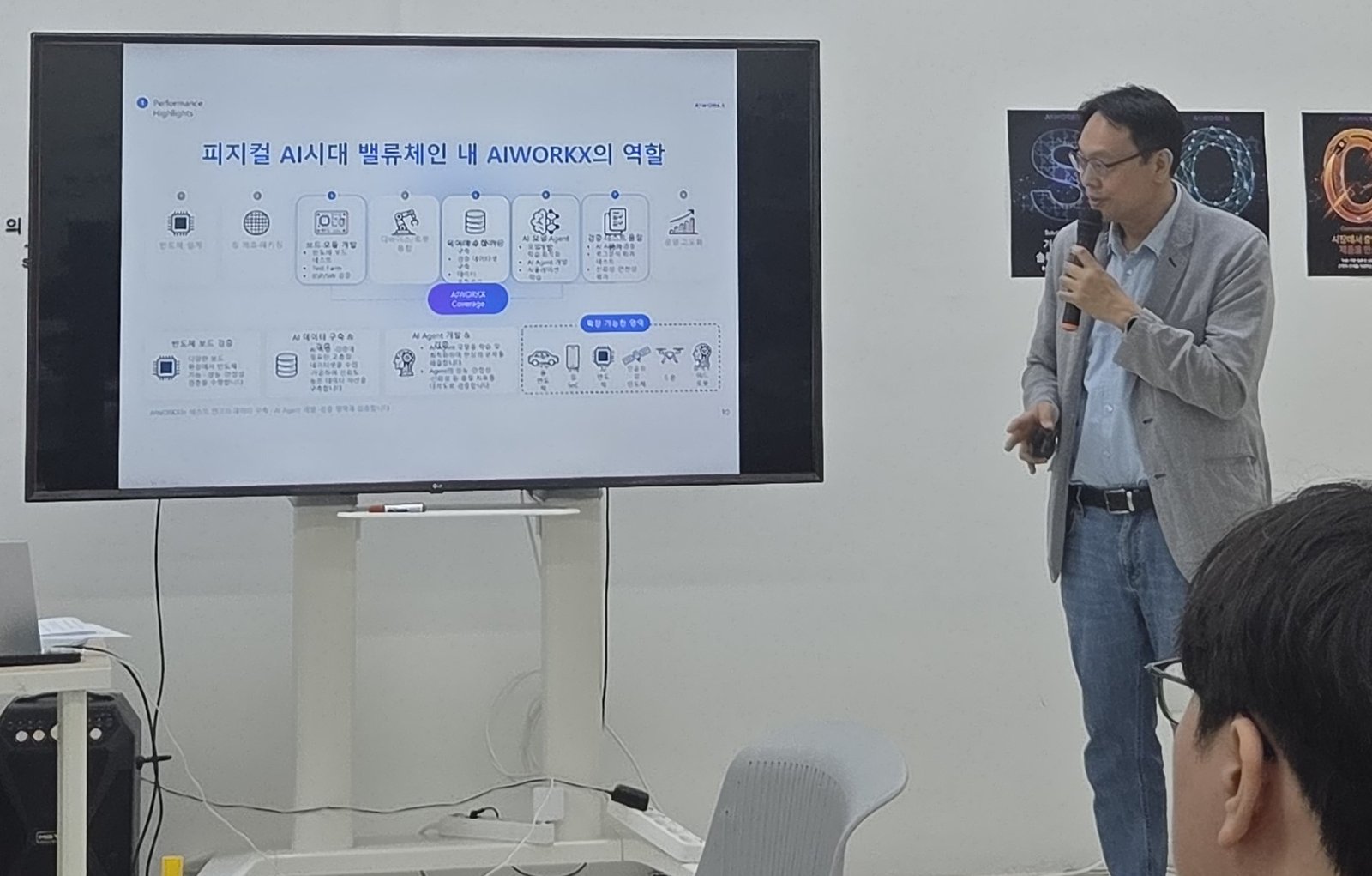
Q1. One year after the rebrand, how do you see the recent changes in AI?
One year since Testworks became AIWORKX. How far have the three directions set alongside the new name come?
The company name changed between late March and April of last year. With the visual identity recently finalized, a rebrand of a little over a year is entering its final stretch. Over the same period, the pace of change in AI technology has visibly accelerated, so the first question was how he views the past year and a half. The very first words were about speed.
“The pace lately is so fast that I can barely keep my footing.”
For the first six or seven years after founding the company, having started in AI early, the feeling was only that “this is a bit different from conventional software.” If the period from ChatGPT’s release in November 2022 to the first half of 2025 felt two or three times faster, the past year has felt about ten times faster than usual. That is his own reckoning.
Yet he did not read the speed purely as a burden.
“We are in the middle of an industrial revolution. Still, there is a lot of interesting work, and I can see new things we need to do. They say heroes emerge in times of chaos. I think we timed the name change well for this moment.”
The idea of changing the company name actually dates back to around 2022. Three things were decided then: to become a company that leads AI transformation, to go solution-centric, and never to forget the social mission. Asked whether, a year on, the company has moved in that direction, the answer was this.
“Nothing dramatic, but the overall direction is going the way I intended.”
Visible results came first from the financial sector. Work supporting AI transformation (AX) at tier-one banks is producing results, and the CodeBridge solution, having passed proof of concept and been delivered as a product, is gaining scalability.
DeviceProbe™ and AgentRigor™ are also finding their footing. blackolive, used for data labeling training and vision data construction, continues to advance into OCR, 3D, and autonomous driving, supporting the data business.
Right after the results came the shortcomings.
“That said, the way the company works also needs to shift more decisively toward AX, and I think we need to prepare a business restructuring around that as well.”
Q2. This year in particular you have received many requests to speak on the digital divide and inclusive AI, and you have advised major government agencies. How do you think about this topic?
His answer to AI polarization was not technology but the common good.
Requests to speak on the digital divide and inclusive AI increased sharply this year. Advisory roles for major government agencies followed. Asked how he sees this topic, the answer was philosophy, not technology.
“Lately I have been drawn to fundamental philosophical questions. People say it, don’t they? That AI will accelerate polarization and split the world in two. It is self-evident that the gap will widen between those who own AI, use it, and reap enormous wealth, and those who cannot. There is a great deal of fear around that, and particular concern about jobs.”
So why do jobs disappear? He located the cause not in technology but in desire.
“In the end, those who have want to earn more, and to earn more they have to cut labor costs. It really comes from that desire.”
He is often asked for an alternative, he said, but the answer he offered was not a technical fix. “I don’t think there is any alternative other than changing our own philosophy.” The word that followed, with the caveat that it might sound too lofty to take seriously, was the common good.
We have to recognize that the wealth of this society is a public good. Nobody takes their money to the grave.
Wealth is only a convenient tool that life temporarily requires. Wealth and economic gain should not rule life. Then came the question of whether a large share of people living under capitalism have themselves been conditioned to it. Anxious as they are, if something promises economic gain, they end up chasing it like mad anyway.
“Unless the recognition spreads that we are people living together for the common good, I wonder whether there is any hope for inclusive AI.”
That recognition has to be the foundation, he believes, before solidarity becomes possible on top of it. When technology is attached to solving a specific problem together, people have no choice but to stand in solidarity.
But because wealth is not recognized as a public good, helping people and applying technology for good gets treated like charity or philanthropy. That point, he said, is uncomfortable.
“It bothers me. Platform companies do these AI-for-good activities, but it isn’t sincere. It’s a kind of showmanship.”
ChatGPT also began with the public-interest purpose of solving hard problems, but ended up accelerated by capital market logic. China is expanding its market through a fast-follower strategy, supplying technology to developing countries free of charge. Beyond the common good, there seemed to be something a hard-nosed executive would add, so we asked once more.
“I am not denying the capital market itself. What I am saying is that unless we recognize this as a public good, there is no way to stop wealth and profit from concentrating among a few, and it will only accelerate. In the end it is a question of philosophy.”
He added a caveat that this philosophy is not his own. It draws on the AI social doctrine issued by the Vatican.
“The basic desire to live a safe and secure life turns into excessive greed, and that greed pushes us toward the extremes of capitalism. Is that right? I worry that AI technology is also being used in ways that feed the extremes of capitalism. Ultimately it is not a technology problem but a problem of philosophy and social systems.”
So what can a company do right now? Here he narrowed the scope and spoke of the small win.
“To put it more narrowly, I think that even amid this polarization, we can use technology to create ‘small win’ cases. That is the direction toward a more sustainable society, and in that sense I think our company is playing a role.”
Showing, on a small scale, that a company can genuinely solve social problems with AI technology. When the public sector cannot solve every social problem, a company stepping into that role can also lead to the creation of new markets. That is his thinking. The scope of the term inclusive AI, he added, needs to widen.
“And inclusive AI needs to go beyond the old, simple notion of inclusive employment, meaning hiring people with disabilities and other underserved groups. We clearly also need players who build up the AI ecosystem itself in a different way, and in that respect I think our company is pioneering new attempts in some areas.”
Q3. The KOICA IBS program: from Vietnam to Cambodia
Why the model of handing down work collapsed, and what was designed differently in Cambodia.
AIWORKX has carried out two KOICA IBS (Inclusive Business Solution) projects. The Vietnam program that began in 2022 has concluded, and the Cambodia program, running through 2030, has begun.
Both projects attempt to address the digital divide in developing countries through inclusive AI. Khmer, designated a low-resource language by the United Nations, gives the work added significance. We asked how the lessons from Vietnam carried over into Cambodia.
“I see the Vietnam and Cambodia programs as representing Phase 1 and Phase 2 of our company.”
Phase 1 was job creation. It began as a data labeling business, training people in developing countries in the manual work that labeling requires and creating employment. Not outsourcing, but impact sourcing.
“From the start I thought outsourcing was greedy, and while searching for the concept of a social enterprise I came across impact sourcing. Companies like CloudFactory and Samasource started with data labeling much like we did and became known globally for impact sourcing.”
The limits of that first-generation model are now showing. The reason he earlier called platform companies’ public-interest activities insincere connects here.
“Samasource kept getting criticized over low wages and working conditions, and this year, when a major platform client terminated its annotation contract, it laid off more than 1,000 local workers in Nairobi. In the end, the structure put all the work in the hands of overseas platform companies. When the client cancels the contract, nothing is left in that country.”
To them, workers in developing countries are a cheap supply chain, not partners to grow with. So when things are good, they promote it as impact, and when things turn bad, those workers are the first to go. That is not impact. That is washing.
So in Cambodia, the design itself changed. Where Vietnam directly hired, or connected to jobs, people with disabilities and other underserved groups, Cambodia expanded into a program that builds the ecosystem itself inclusively. It also moved further toward solutions.
“If the first generation was job creation, this is ecosystem building, second-generation impact sourcing. Instead of handing down work, we set up a self-running system inside the country and then step out.”
In practice, this means building a Khmer language model, training the people needed while building a lightweight model, and then building agents that run on top of it. The goal is a sustainable AI ecosystem inside Cambodia. What he emphasized was, again, sustainability. “What matters is that we build a sustainable business.”
There is one more layer of meaning. Korea’s experience and know-how in sovereign AI can be transplanted to another country. He sees this as an important AI ODA strategy from Korea’s standpoint.
“ODA is mutually beneficial. It is not about marching in with technological superiority, like technological colonialism, dominating the market and maximizing profit. What matters is transplanting our technology while solving the problems that country faces together, and jointly building a sustainable ecosystem.”
The final meaning connects back to the previous chapter. It shows that a business pursuing public value can be led by a company that holds public values.
Q4. AI trustworthiness and safety are the topic of the day. How do you read this landscape?
For a company that began in software testing, the next thing to verify is the humanoid.
With the AI Basic Act in force and development speeding up, AI trustworthiness and safety have become the topic of the day. At the WAIC exhibition in Shanghai, he remarked that “the speed, the scale, and the attention, all happening at once, are all astonishing.” In Canada, he introduced the concept of verifiable and confirmable LLMs and presented on the catastrophes that follow when AI is misused. Having traveled to several countries this year, how does he read the landscape?
“With agentic AI just now being applied in the enterprise, trustworthiness naturally has to be verified, and it is bound to be everyone’s topic. Because our company started in software testing, verifying whether AI-based products are safe and trustworthy as they are commercialized is what we can do best.”
And he sees the next arena as robots.
The final boss of AI will be physical AI, robots, and the robot scene is truly at the R&D stage, the starting point.
On the AI Basic Act, he added that AI ethics must also be attended to. Someone has to watch for particular groups being excluded, for biased training, and for unethical statements or outputs.
Robot trustworthiness is especially hard because there are so many layers to check: hardware quality, quality at the point where hardware meets software, quality of the software layer, and quality of the integrated system layer. His judgment is that companies able to cover that entire span are rare.
“I wonder whether we are the only company that can verify quality end to end, from upstream quality at the front to downstream quality. I am thinking that a player is needed to properly verify and take responsibility for the quality of things like humanoid robots, the final boss of AI.”
What is needed is data and expertise.
“To do that well, you need high-quality data and verification data, and you need expertise and technical capability across a wide range of layers, like a full gift set. I think all the experience, know-how, and data we have accumulated will feed into that. AX is ultimately a topic that covers the whole of AI software, and that was a somewhat easier game. Once hardware comes in, especially robots, it becomes a truly comprehensive field. I have built robots myself, so I know. It really is not easy. I think there is an endless amount to do there.”
Asked whether robots would be adopted in industry before humanoids, he did not divide it into stages.
“I think it will happen across the board. One day it just suddenly rushes in. Tesla already says it is producing them. Once robots become part of daily life, the atmosphere will change enormously.”
His picture of the landscape has two branches. On the hyperscale side, models keep getting larger. On the side that penetrates daily life, robots enter our lives. Edge AI will center on robots, and giant models will be dominated by a handful of top-ten platform companies. “Korea talks about being in the global top three. I hope at least one Korean company makes it into the top ten.”
Q5. AIWORKX, a social enterprise in its eleventh year: what it does well and what it lacks
He has been urged many times to drop the social mission. Each time, his answer was that the order was wrong.
AIWORKX is in its eleventh year. The five-year survival rate of Korean startups is around 30%, about half the average of major OECD countries. Narrowed to software and online services, the five-year survival rate is 28%, and roughly one in ten companies passes the ten-year mark. Survival itself has not been common.
So we asked frankly what the company is most confident in and what it still lacks. The confidence was in attitude, not technology.
“What we do best is finishing work responsibly, all the way to the end. Watching our people work is remarkable. Somehow they take responsibility, see it through, and earn customer satisfaction.”
Here he brought up something heard in Shanghai. A self-described AI PhD said that, apart from the top few global companies, the technology gap is no longer large, and what is truly hard to copy is trust capital.
“And the trust capital we have built up is quite solid. Customers are satisfied, and we are establishing ourselves as a company that takes responsibility. I think that is where we are most confident.”
The shortcoming was short and clear.
“I regret that word hasn’t spread as much as our capability deserves. That is our company’s weakness, if you like: marketing. From now on it will go well.”
One more question. AIWORKX started as a social enterprise and has gone through successive investment rounds. In the impact ecosystem, the diagnosis that “the brand of a good company alone does not bring capital” is already widely shared, and in the capital market, some see social value as a constraint on growth.
He must have been pressed to give up one or the other, so we asked how the company got through. “I have received that suggestion many, many times.” But he overturned the premise of the demand itself.
“I think the order is wrong. The reason we survived is precisely the social mission. We stuck with hard problems from when there was no money in them, so now, in that area, there is work only we can do.”
There is a common belief that good companies don’t last. We have come eleven years and are preparing for an IPO without ever having set down the social mission. We are proving that social value and sustainability do not push each other out.
One of AIWORKX’s core values is Trust. At a CEO staff lunch, someone described the team as “tough ones who will guard goodness,” and that phrase came to mind here.
Finally, we asked him to sum up 2026 as an AI entrepreneur in a single sentence. The answer was this.
“That’s a question I hadn’t thought about. I think we are somewhere between evolution and revolution. Too revolutionary to call evolution, but it still feels like we are changing while keeping the company’s fundamental constitution.”
When we suggested that, in his favorite vocabulary, that would be closer to transformation, he replied:
“Right. From the early days I talked a lot about transformation. But these days we have to transform so often that it’s exhausting. It’s supposed to be something you do once or twice in a lifetime.”
After the official interview: two things on his mind these days
What came after the question sheet was closed. The tone was clearer than any answer given that day.
As we were packing up, he kept talking. These were not prepared answers. There are a few things, he said, that snag whenever he talks about inclusive AI.
The first is “human out of the loop.”
“When I talk about inclusive AI, a few things bother me. One is the argument that jobs will shrink as we shift to robots, and since robots must be fully deployed for industrial innovation, it’s fine if there are no jobs. Some people talk as if building a fully automated factory were the picture of robotics we are pursuing. I really don’t like that. The concept itself presupposes human out of the loop.”
The reason he calls this a question of philosophy is that it ultimately comes down to what kind of social system we want to build.
It is not a matter of right and wrong but of choice. What matters is what consensus the members of society hold. It probably comes down to the fine line between need and greed.
The second is the startup scene.
“The second thing that grates on me is the startup scene. One recent direction in the startup scene goes: ‘Let go of all the employees, AI does everything, one hero CEO carries the company, and it’s great not having to worry about staff.’ Some people talk up companies that try to solve everything with AI.”
He agrees that some portion of work must shift toward using AI. But the reason for the shift, he believes, is different.
“The reason for AI transformation is not to eliminate employees but to manage transparently on the basis of data. When you transform into an AI-native company, communication and decision-making move transparently around data rather than individual subjectivity or intuition, and that creates procedural fairness. That is the lens for looking at AX. Instead, one side pushes efficiency and cost cutting to the extreme, and the other side tries to use it as a means of avoiding relationships with employees, with people.”
Such startups, he said flatly, will never grow. At some point there are clear limits to what AI can do, and people become necessary. Running a business and leading an organization inevitably comes back to human relationships and organization, and to pushing through difficulty somehow.
“A slogan like ‘replace ten employees with AI’ isn’t wrong as such, but doesn’t it risk damaging the very culture of working together? In work, working together matters enormously. A workplace is not just a place to earn money. It is a place where relationships follow, a stage of life. There is a sanctity that labor gives.”
The two stories came back to the same place.
In the end, I think the root is a question of philosophy. All these phenomena reflect the desires of people living in this age. Look at the crazy stock market: people made their own decisions and invested on their own initiative, yet so many of them rage and despair. Isn’t AI ultimately a mirror of human need and desire? So I am reading philosophy books again.